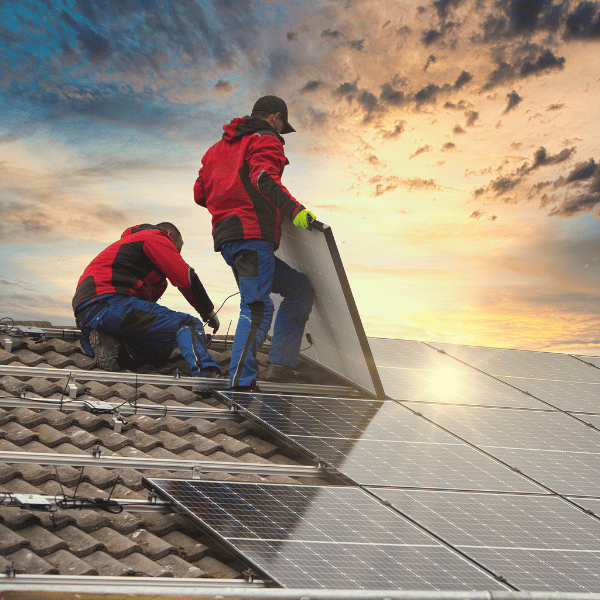

This document is a model job description for a senior installer working on commercial and industrial solar PV installations. It has been developed by Solar Energy UK’s Skills and Workforce Steering Group and sets out the key responsibilities of the role, as well as the skills and qualifications expected. It is expected that the installer will work with an electrician competent to work on these arrays.
Overview:
The Senior Solar Installer (SSI) shall be responsible for all aspects of installing solar PV on a commercial or industrial roof, except for the final electrical connections and commissioning of the array. This job description applies where the array is large enough to warrant a non-electrical lead to install the mechanical systems on the roof.
The SSI will generally report to a solar project manager and work along side a solar electrical professional. It is expected that they will have a team of installers working with them, for whom the SSI is responsible.
Discuss and understand the project scope of works, identify and adopt position in CDM (Construction Design and Management) regulations hierarchy and adhere to relevant status.
Responsibilities:
The core responsibility of the SSI is to install the non-electrical infrastructure, including supporting steelwork, panels, cable tray and electrical junction boxes. The SSI is responsible for the team that undertakes this work and for coordinating with the solar electrician and the Project Manager. Key issues that the SSI will need to oversee include the health and safety of staff on the project, the accuracy of planning and installation and the quality of workmanship.
Planning
Understand the scope of works of the project. Be confident to ask the appropriate engineer / designer if the scope is unclear.
Be confident to question / analyse the scope and method of the project delivery.
Understand the codes of practice governing installation and the manufacturer’s recommendations for successful installation.
Plan the workflow, gaining critical information from all stakeholders (suppliers, stores, designers, consultants, sub-contractors, or clients) to understand the critical project programme. This will include an intimate knowledge of the mounting system and its connections, to understand the installation sequence and controls, such as torque on bolts and the specification of the fixings to ensure they are compatible with the roof and the mounting system.
Understand a roof loading sequence and allowable loads and ensure that these temporary works are designed by a competent temporary works engineer.
Develop program of works in conjunction with the Project Manager and client, highlighting potential delays or circumstances halting works, allocating resource / sub-contractors / specialist contractors as appropriate.
Review the Health and Safety File, that is available under the CDM Regs. Ensure that all suggested actions to manage risks are included within the programme.
Set (or agree) site rules, including working hours and maximum wind speeds.
Prepare risk assessments and resulting method statements as necessary, using design information, product specifications, best practice and awareness of the staff delivering the project.
Review the contract for rules that relate to the delivery of the infrastructure. These may include working hours, control of variations and authorities to work, such as a permit to work.
Visit the site, to ensure that all local issues are accounted for and planned. Where an in-person visit is not feasible then a virtual meeting with the site manager to introduce the contact will be valuable.
Mobilisation
Conduct site inductions and ensure that all risk assessments and method statements are both understood and signed for by all members of the team delivering the project.
Ensure that all site staff are appropriately trained and competent for the role that they will undertake. Ensure that all know the site rules and promote a culture of safety, accuracy and competence.
Ensure that suitable access is installed and that all safety features are installed and signed off by a qualified person. Ensure that competent welfare facilities are provided and set up prior to staff arriving to deliver the array.
Ensure that all staff are competent to carry out the duties that are assigned to them within the installation team.
Review the terms and conditions of any subcontractor that has known.
Oversee the initial setting out of the array to ensure that location is secure and as designed.
Delivery
Manage the staff to deliver the project in accordance with the project programme.
Receive material deliveries. Ensure that all materials comply with the specifications provided by designers. Where no specification exists then ensure that the designers are happy with the products and materials that are used.
Ensure that all plant and equipment is appropriate for the tasks in hand.
Carry out spot checks and oversight of setting out, fixings and general quality of the materials and its install.
Notify and obtain direction in writing for all variations from design that are encountered.
Ensure daily records are kept of working hours, achievements and delays, including weather delays. Report these in accordance with the contract.
Ensure that method statements are adhered to and where necessary carry out discipline action or amend the method statement to better suit a safe way of working.
Ensure that installation workmanship is checked and signed off. Ensure that all necessary paper or electronic records are maintained.
Handover
Conclude the handover manual to include an O&M manual that covers the non-electrical infrastructure.
Conclude all records, including the electronic record under the Building Safety Regulator.
Skills:
Strong communication skills. Communicate clearly to operatives, colleagues, clients and key stakeholders.
Be willing to work in a team.
Programming
Leadership qualities, take responsibility in decision making.
Manage and mitigate risk.
Can delegate and collaborate.
Have an open mind to learning.
Be able to keep a level head in adverse situations.
Have respect for fellow colleagues and their opinions.
Reading and writing in English to NVQ Level two minimum. This includes an ability to read drawings and specifications.
Physical Requirements
Prepared to work outdoors and in variable weather conditions
Comfortable working at height on roofs, ladders and elevated platforms
Ability to lift 50lbs and large solar panels
An ability to use power tools safely and efficiently.
Qualifications & Experience:
Essential
A levels or Diploma
Solar qualification of any variety, provided that it is backed up by suitable experience.
A minimum one year of experience in commercial and solar installations, which must translate into a good knowledge of C&I solar installations. (Traditionally, this will be from working within a gang to taking responsibility of the gang.)
SSSTS (Site Supervisor Safety Training Scheme) or equivalent
Basic first aid
Qualifications to progress to:
CDM awareness / CIOB (Charted Institute of Building) fundamentals
PRINCE2
NABCEP Certification (PVIP) or equivalent
Electrical or roofing apprenticeship
First Aider


.png)
.png)